
€150/mo, on top of your plan
Verification
KYC and KYB, decided by your own people.
Identity verification for individuals and business verification for companies, run inside your own platform with no external verification vendor — and a standing the rest of the platform gates its own steps on.
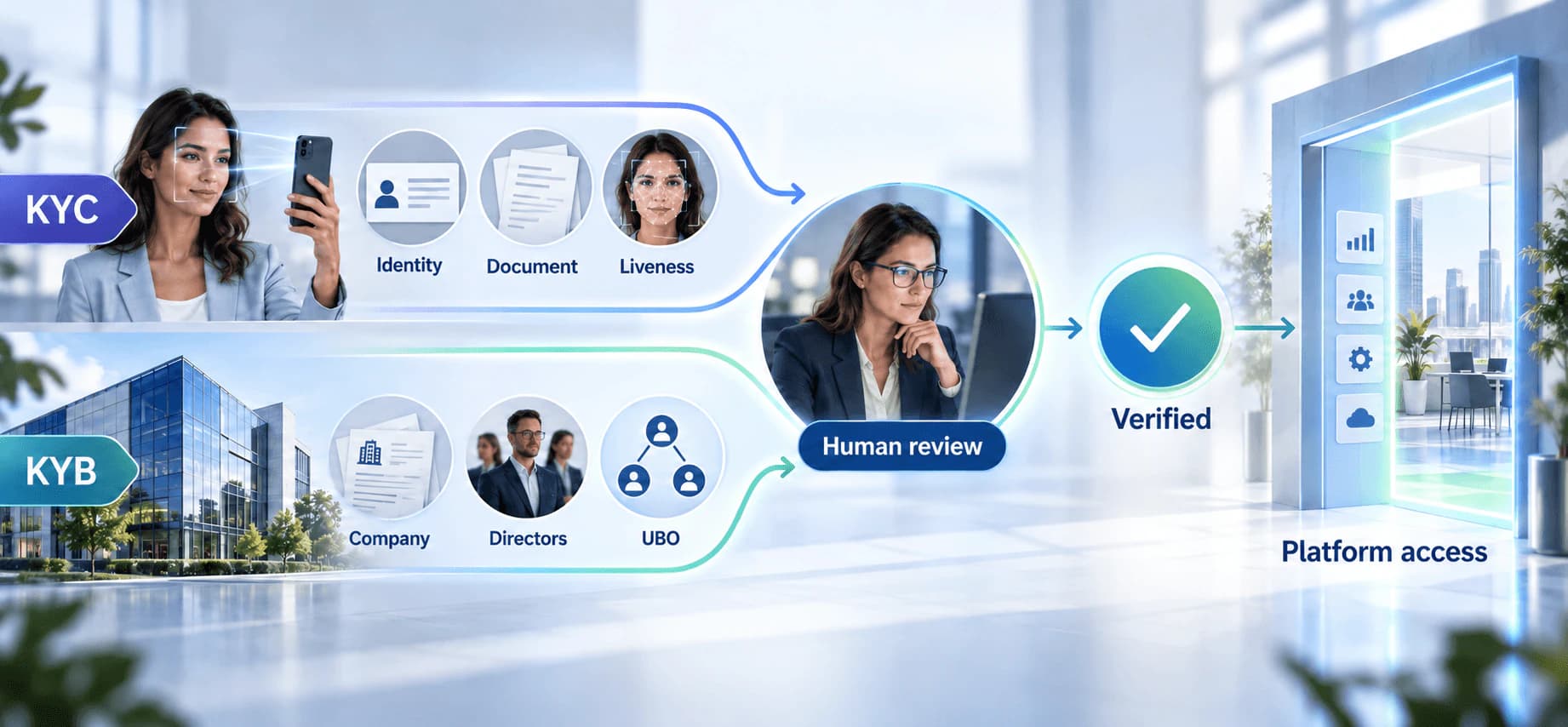
- Verification kinds
- 2
- External verification vendors
- 0
- Languages in the wizard
- 3
- Unaudited document views
- 0
One flow, two audiences
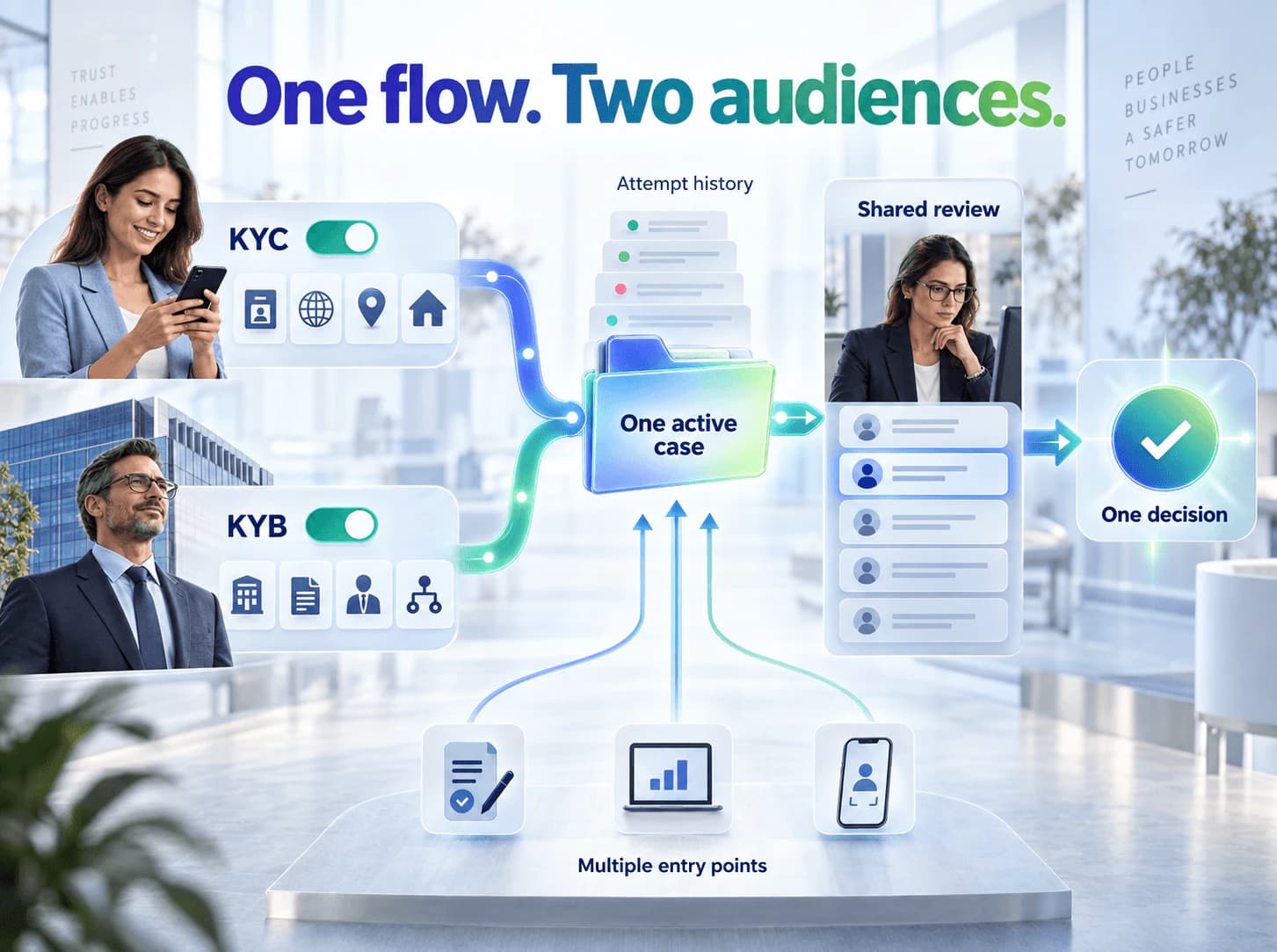
Individuals go through KYC and companies through KYB — the same case, the same queue, the same decision. Either can be switched off on its own.
- KYC: identity document, nationality, registered country and residential address
- KYB: company registry data, company documents, the representative's own KYC and the owners behind the company
- Started from an onboarding task after signup, a dashboard widget, or the user's own verification page
- One active case per person per kind, with every earlier attempt kept in its history
A guided wizard, in the applicant's language
The applicant is walked through it step by step in English, Dutch or German — and can move to a phone when the desktop has no camera.
- An identity document, captured with the camera or uploaded
- A photo of the applicant holding that document beside their face
- A short challenge-response recording — the platform issues random digits to read aloud, and a reviewer watches it
- A phone number confirmed by one-time code, with send and attempt caps
- No webcam? A QR code moves the applicant to their phone without a second sign-in, and the desktop shows that the phone is connected
- The document's machine-readable zone is read on the applicant's own device to prefill the fields — nothing is trusted until the applicant confirms it
- Your own extra fields can be added to the wizard
Reviewed by your own people
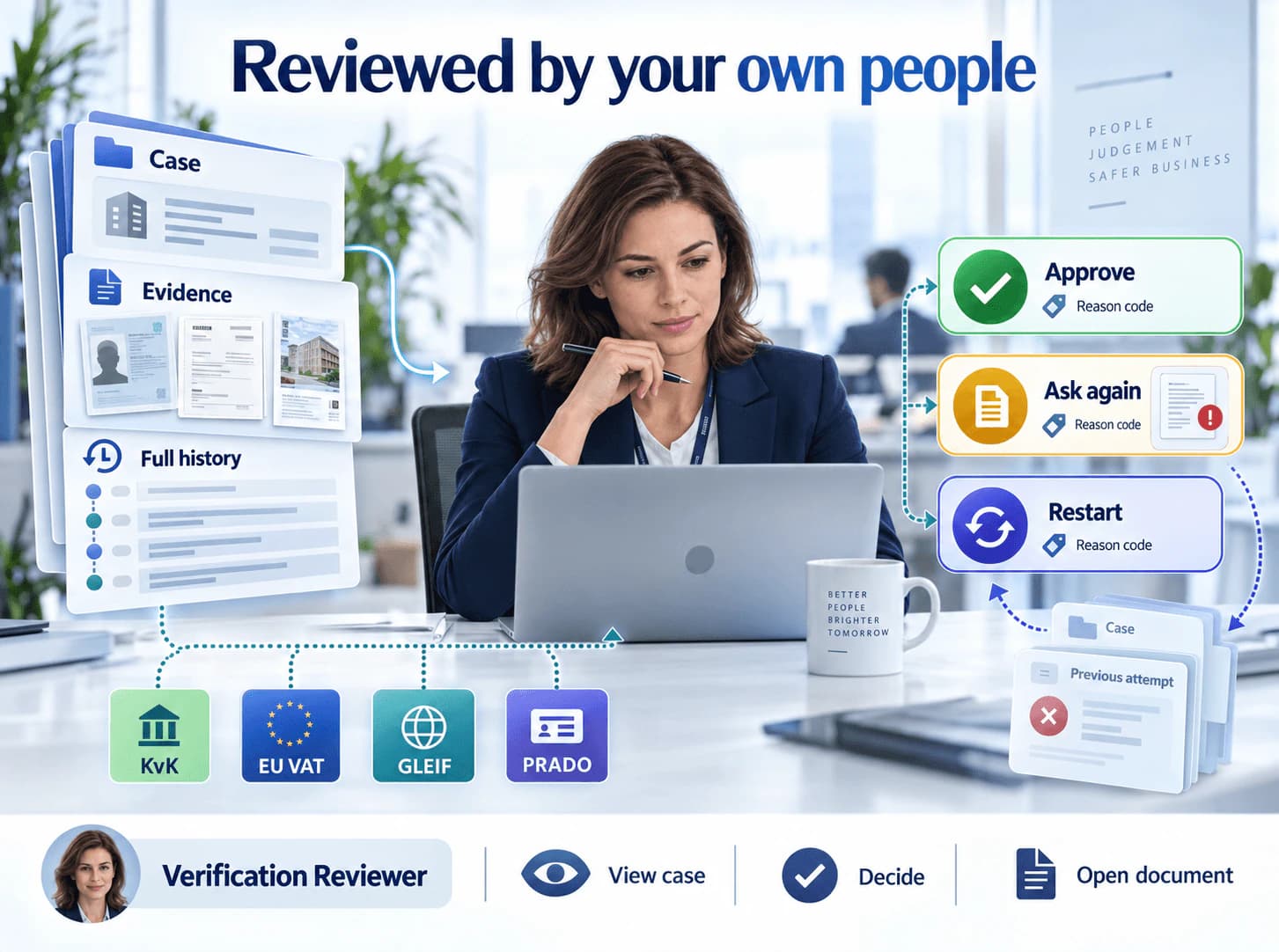
There is no external verification vendor and no government identity registry behind this. Your reviewers open the evidence and decide.
- A queue with the case, its evidence and its full history on one screen
- Three decisions: approve, ask for one specific thing again, or send the case back to the start
- Every decision carries a reason code, and an applicant who is turned down can always try again
- Reviewers cross-check public registers — the Dutch KvK, EU VAT numbers, GLEIF and PRADO — as part of their own judgement
- A Verification Reviewer role ships with the module, and seeing a case, deciding it and opening a document are three separate permissions
The company paperwork, slot by slot
Business verification asks for exactly the corporate evidence a reviewer needs, in four groups.
- Proof of legal presence and company details from the register
- The ownership structure, and the authorisation of whoever signs for the company
- The representative completes their own KYC as part of the company's case
- Ultimate beneficial owners are declared by the company and proven with documents, above an ownership percentage you set
- An EU VAT number is checked against VIES when the company profile is saved
Encrypted before it reaches your storage
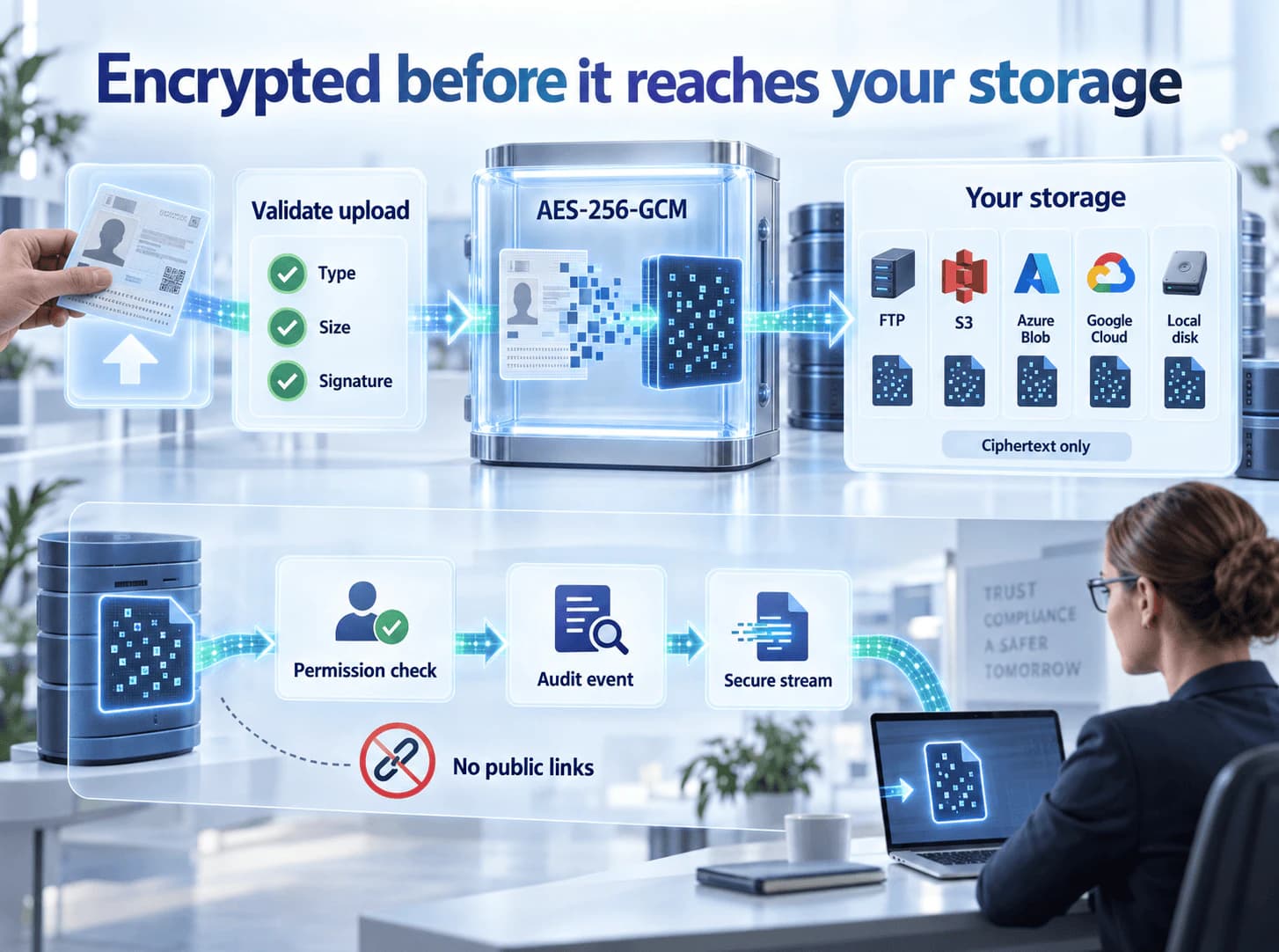
Identity documents are the most sensitive files a platform will ever hold. Every one of them is encrypted inside the platform and written as ciphertext to the storage you already configured.
- AES-256-GCM envelope encryption, applied before the file leaves the process
- Your own storage — FTP, Amazon S3, Azure Blob, Google Cloud or local disk — holds ciphertext and nothing else
- Downloads exist only as permission-checked endpoints; there are no public or shareable file links
- Every single view of a document is written to the audit trail before the bytes stream
- Uploads are checked on type, size and file signature before they are stored
GDPR and Wwft, built in rather than bolted on
Holding identity documents brings obligations. They are part of the module, not a policy document you write afterwards.
- The lawful basis you rely on is recorded, and it decides how much of a document number the module may keep at all
- A retention period you set, with a daily sweep that destroys the evidence when the window closes
- An erasure request and a full data export for an applicant who asks — served today by your administrator over the API, with the panel buttons still to come
- An audit line for every state change and every document view
- A DPIA template and a tenant compliance guide ship with the module
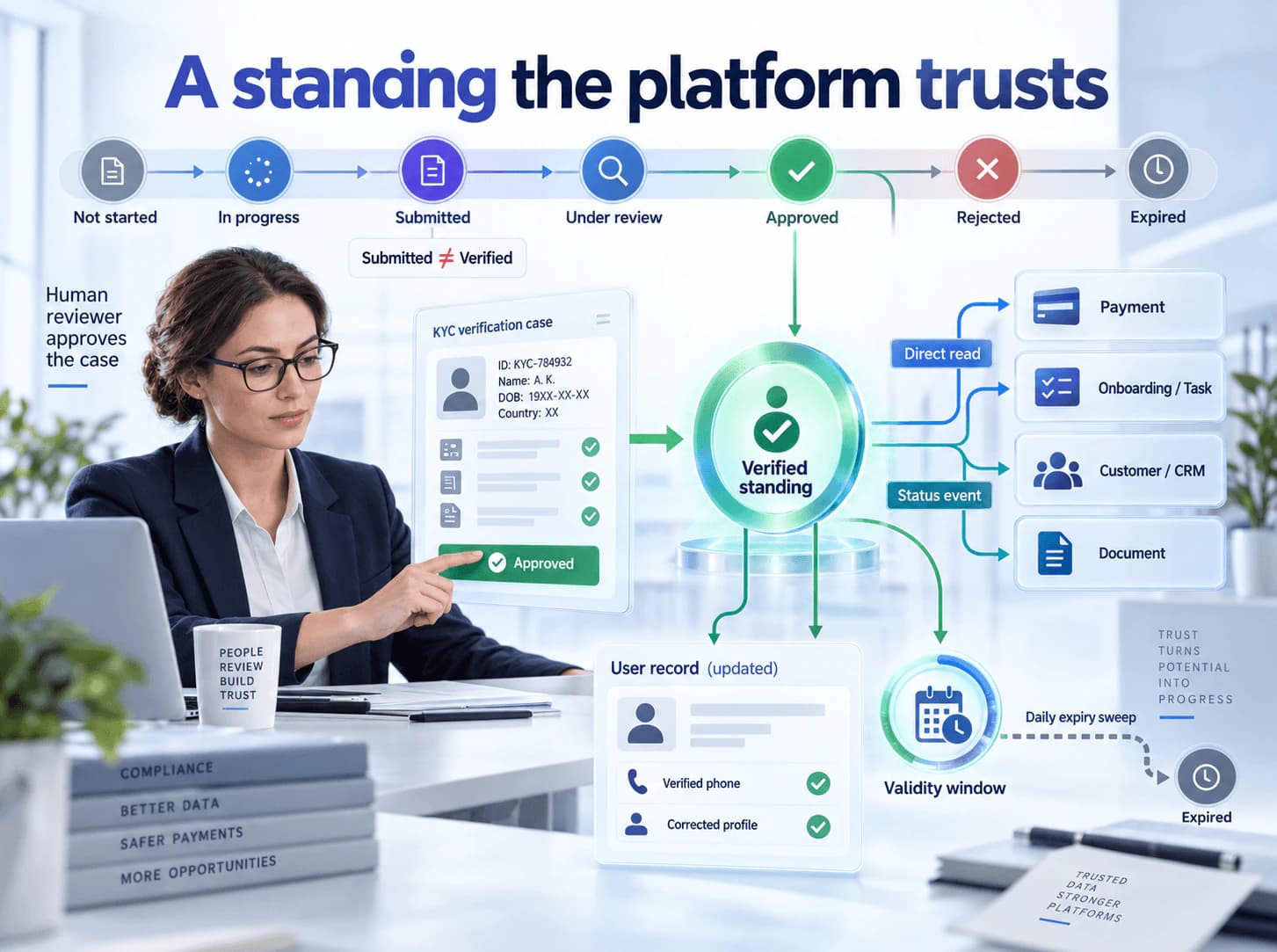
A standing the rest of the platform trusts
Submitting is not passing. A case counts as verified only once one of your reviewers approves it, and everything downstream keys off that.
- Seven clear states, from not started through under review to approved, rejected or expired
- On approval the verified phone number and the corrected profile details flow back to the user's own record
- Other modules read the standing directly, or react to an event when it changes
- An approval can be given a validity window, and the daily sweep expires it when it runs out
Worth knowing: A person makes every decision, so a case moves at your team's pace rather than in seconds — and the module reads no government identity registry, which is why beneficial owners are declared and proven with documents rather than looked up. It verifies identity; it does not move money.
What every module inherits.
- Installs from the marketplace with no redeploy — the menu and the permission list update immediately.
- Creates its own tables, in its own schema, inside that customer's database.
- Packages are cryptographically signed when they are built, and the signature is checked before the host unpacks one.
- Uninstall switches a module off and keeps its data. Dropping the tables is a separate, deliberate choice.
Want to see Verification running?
Thirty minutes, a live workspace, and an honest answer about what each module does and doesn't do yet. Missing a module? A custom build is a fixed-scope project, from €25.000.
Book a call