
Will need Verification
Verification providers
Sumsub or Persona, on your own account.
The same verification cases, decided by a regulated verification vendor instead of your own reviewers — for teams that want checks in seconds and can carry a per-check bill.
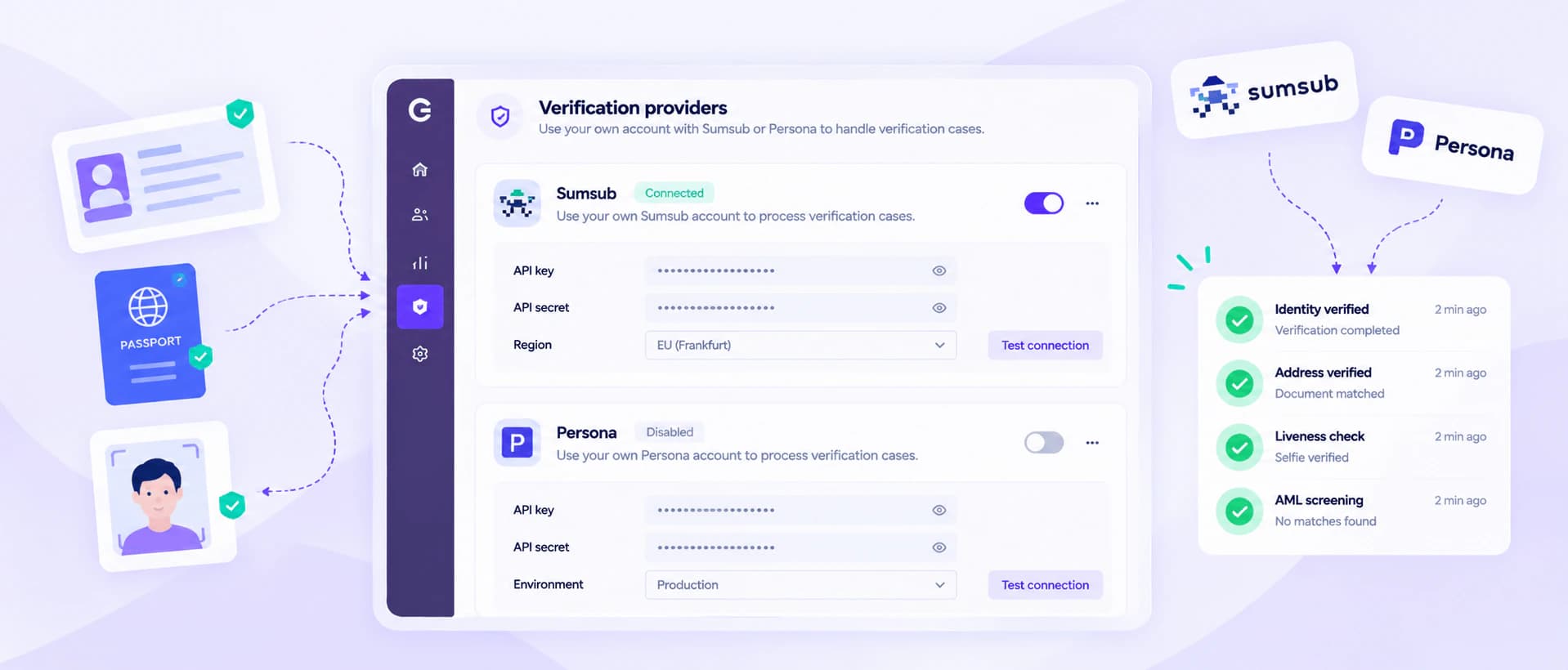
In development — this page describes what the module is being built to do, not what you can install today.
- Providers planned
- 2
- Shared or house accounts
- 0
- Changes to the modules that gate on verification
- 0
Two ways to answer the same question
Verification answers who someone is with your own reviewers reading the evidence. That is the right answer for most teams: no per-check bill, no third party holding your applicants' documents. It is the wrong answer when volume is high and an applicant will not wait for a person.
- Manual review stays the default, and stays free of a per-check fee
- A provider will be something you switch on, not something you migrate to
- Which one you use will be a setting, so a team can start manual and change its mind
Your contract, your keys
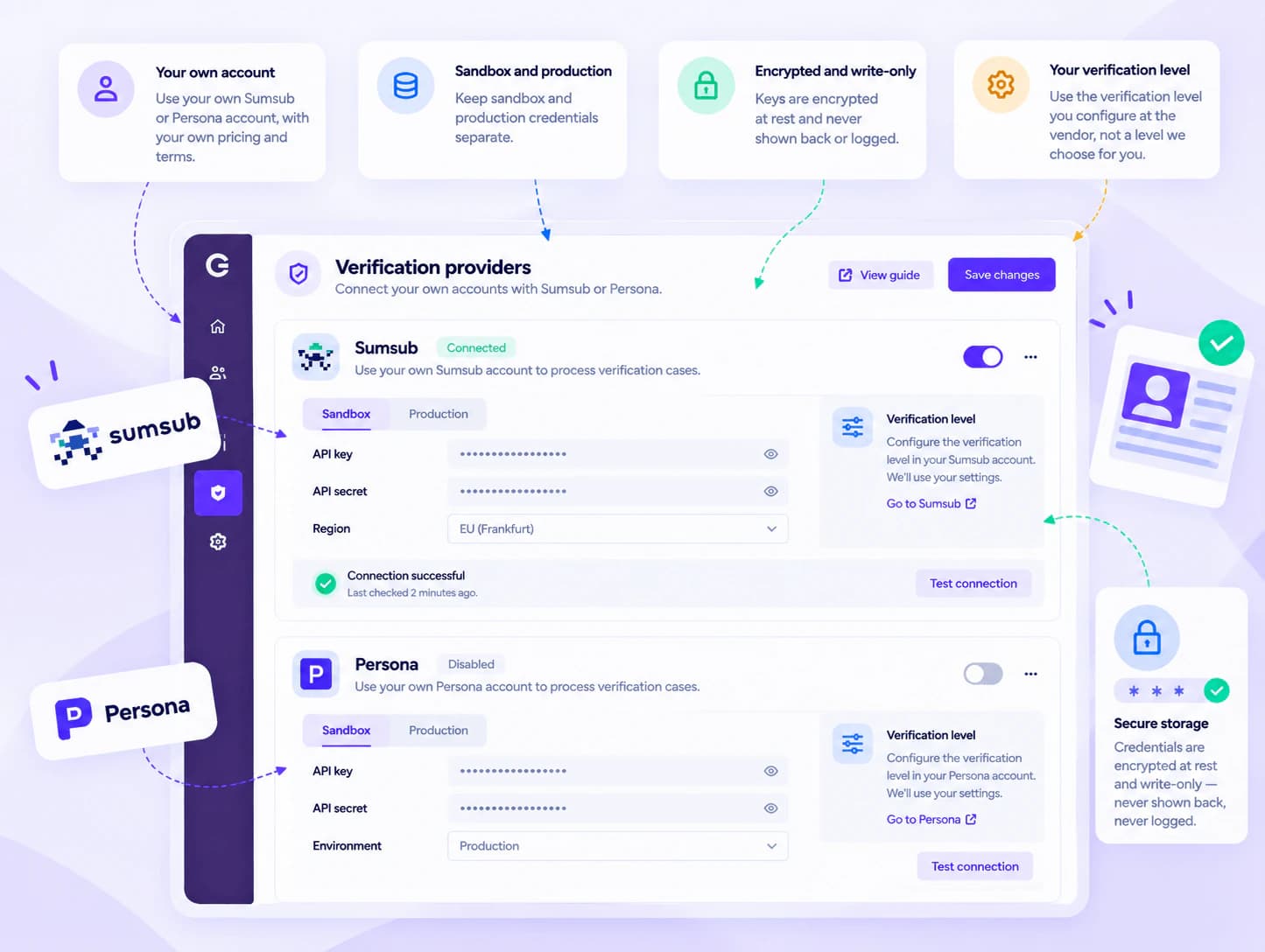
The same model as the PSP provider modules: you hold the vendor contract and enter your own credentials. The platform will supply the integration, never the account.
- Your own Sumsub or Persona account, with your own pricing and your own terms
- Sandbox and production credentials kept apart
- Keys encrypted at rest and write-only — never shown back, never logged
- A verification level you configure at the vendor, not a level we choose for you
The same case, a different decision-maker
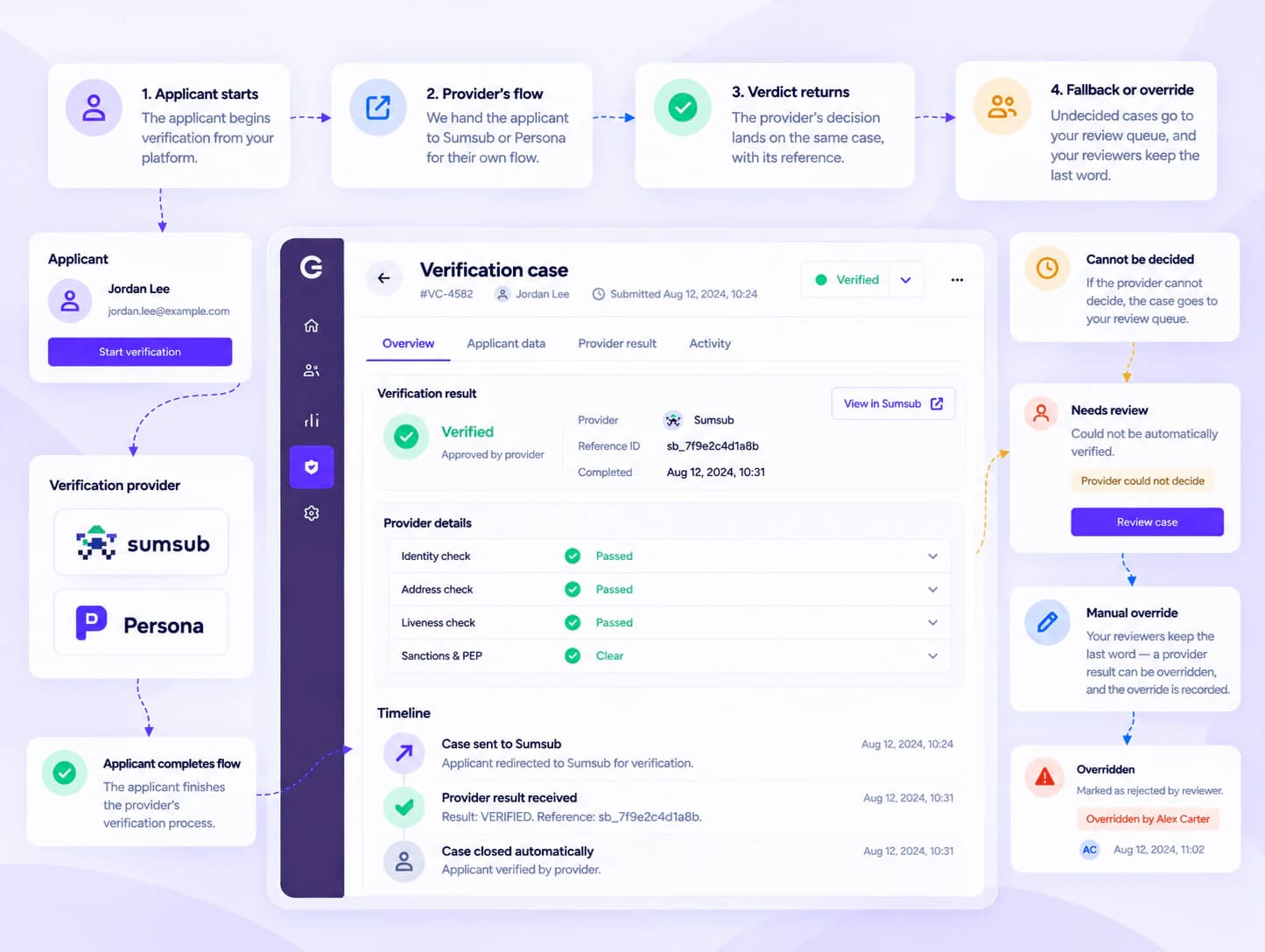
An applicant will start the same way and land in the same case. What changes is who decides it.
- The applicant is handed to the provider's own flow and comes back to the platform
- The provider's verdict lands on the case, with its reference kept for your audit trail
- Anything the provider cannot decide falls back to your review queue rather than stalling
- Your reviewers keep the last word — a provider result can be overridden, and the override is recorded
Nothing downstream has to change
The standing, the events and the permissions stay the Verification module's. A module that gates a step on verification today will not know which way the answer was reached.
- The same states, the same status on the user record, the same events
- The same retention clocks, erasure workflow and audit trail
- Switching a provider on will not re-open cases your team already decided
What every module inherits.
- Installs from the marketplace with no redeploy — the menu and the permission list update immediately.
- Creates its own tables, in its own schema, inside that customer's database.
- Packages are cryptographically signed when they are built, and the signature is checked before the host unpacks one.
- Uninstall switches a module off and keeps its data. Dropping the tables is a separate, deliberate choice.
Works with
Curious where Verification providers is heading?
Thirty minutes, a live workspace, and an honest view of what is built and what is still ahead.
Book a call